Wednesday, December 2, 2015

FRACTURED WHEELS #1 and #2


NOTE about colors: The true colors of these pieces are somewhere between the light and dark in these photos. 

These two 12" squares started out as the answer to the challenge of interpreting a photo of  an old wheel

Here's the photo of the old wheel. The photo was taken by a member of the Creative Camera Club of Lexington. Unfortunately, I do not know the name of the photographer. Their photo is being used in conjunction with the Quilt Artists of Kentucky on the Quiltography Project 2015-2016.  Those of us who have chosen to participate must agree to interpret a published photo in whatever style we see fit, as long as the piece is 12" square.


I started with two squares of fabric, one from a light colored commercial batik and one a dark color. In this case beige and blue.  I free hand cut the squares into curved pieces, then switched out the pieces to create two blocks. I pieced the blocks and then quilted them. I free motion quilted, using my home Bernina Machine, with Madiera FS20 Bronze metallic thread.

After quilting each square, I cut circles out of them and placed them into the alternating piece. I used a wide zizag stitch to anchor the circles into the holes.


Once I had the circles anchored into the holes I started adding embellishments.  Fuzzy yarn outlines each shape in the piece with the light background. Shiny ribbon outlines the shapes in the piece with the blue background. 

  I found some lamp glass beads, glass leaves and glass chips to use on the pieces. Even after I started  adding in the beading,  everything looked a bit dull still, so, I decided to see what would happen if I colored in each of the circles with water color pencils.  You can see where I started with the circle in the lower right hand corner.


In these photos you can see how I shaded in each circle and then painted a white highlight on each circle. I also painted the grass.


After coloring in each area, I went over everything with Golden GAC 900 fabric medium. The colors blended beautifully and were deepened in shade.

Last of all, I added in some painted highlights to the blue pieces. 

The square with the light background is my official entry into the Quiltography Challenge.  All of the work will be on display next November in downtown Lexington, along with the original photos. 

These two pieces were so much fun that I decided to see what would happen if I created two more squares, painted them, fractured and then put them back together. 

I ended up with FRACTURED WATERCOLOR GARDEN. 


More about that in another upcoming post. 

CREATING ALWAYS with JOY,

Karen


Saturday, November 7, 2015

FLYING SWALLOWS BARN QUILT


I designed and made this small quilt to give as a door prize at the Woodford County Barn Quilt Road Rally. Folks have come in from all over to drive our back roads and take photos of our barn quilts. 


The piece is an interpretation of our Barn Quilt which is based on the "Flying Swallows" quilt pattern. Our barn quilt is 8' square and is quite a presence on the landscape. Over the last few years, I have talked to several people who stopped to take photos of it. One day, I went out to say hello to someone and it turned out to be a quilter that I had met many years ago at a Kentucky Heritage Quilt Society Getaway. We remembered each other immediately.


The pattern is a difficult one to draft and even more difficult to hand piece ( I wouldn't even think of trying to machine piece a twelve inch square), so, I drafted it on freezer paper, ironed the freezer paper with the drafted design onto a piece of white cotton, made a quilt sandwich ( or should that be a quiltwich?) and quilted in the basic lines of the pattern.

I then proceeded to color in the different shapes using Derwent Watercolor pencils.


This photo shows the shapes all colored in and the colors sealed with Golden Fabric Medium.  I am adding in more detail quilting.  


Here is the piece with the rest of the quilting. At this point, I am also ading in another layer of color using more of the water color pencils and fabric paints by Stewart Gill.


To finish up, I beaded in small clear crystals where several of the points come together. I finished the edges with a black ribbon and satin stitch edge.  I then mounted the piece onto a 12" square artist canvas on which I already painted the edges black.  


Hopefully, whoever gets to take home this little "Barn Quilt" will really enjoy it. I certainly enjoyed making it. Now that I think of it, it would be fun to make someone elses Barn Quilt for them. 


CREATING WITH JOY and PASSION,

Karen


Monday, November 2, 2015

IRONS

IRONS for the STUDIO


 The other day I started to iron a piece of silk. I plugged in my iron, a Retro Black & Decker that I've had for at least 15 years, let it heat up and then started to iron the damp fabric. The iron was barely lukewarm. 


Well, I thought, I have put it to good use over the years, with the setting mostly on cotton and linen, so I figured it must be time to invest in a new one. 


 I remember that I paid $25.00 for this one,  at a local appliance store that is no longer in business.  I also remember thinking that I had gotten a really good deal. 


Here was an iron that was not going to keep turning itself off while I was trying to use it.  I also knew it was going to get hot enough to seriously press cotton fabrics, plus, I was tired of spending big bucks on irons that didn't last over a couple of years.


I didn't even know if the iron was still being made, so, I decided to check for it on Amazon. Yep! There it was and for only $21.95.  Since it takes me 45 minutes to drive into town from our farm, I went ahead and ordered the iron. 


While I waited for the new iron to arrive, I decided to check the extension cord that I had been using on the old iron, which was still in the studio.  That's when I discovered that the extension cord had somehow gotten pulled partway out of the wall socket. 


Once I had it plugged in all the way, the iron heated up and worked like a charm. 


The new iron arrived the next day and I'm keeping it. It has a lovely, shiny clean sole plate on it. The old iron has seen some rough use with embellishments that had created dark spots, on the sole plate,  that just will not come off. 


So, now I have an iron to use with melty, sticky stuff and one for clean fabric. 


Does it get any better than that for a fabric artist? Actually, yes, but that's another topic.


Create Always,

Karen


QAK QUILTOGRAPHY CHALLENGE 2015/2016
INTERPRETING a PHOTO of a LEOPARD

The Quilt Artists of Kentucky have started a new Quiltography Challenge using photos taken by members of the Creative Camera Club of Lexington, KY. We will be exhibiting our interpretations of the photos, along with the photos, in November of 2016.


Here is the first posted photo:


  I wanted to try a new fabric manipulating technique, that was posted in the blog "and Then We Set It On Fire", that creates permanent bubbles, creases, folds, etc. according to how the fabric is stitched.  I chose a synthetic gold organza and used stitching around rocks to create a variety of bubble sizes and shapes.  This technique only works with synthetic fabrics that are sensitive to heat.


 Once the fabric was stitched, it was put into a pot of water and brought to a boil.  I boiled it for about 20 minutes. I turned off the heat and let it cool in the pot. Once it was dry, I very carefully removed the very tight stitching around each of the rocks. When I try this technique again, I'll be sure to use looser stitching.

Here is the fabric after I have removed the rocks.


Look at all of those cute little bubbles. I thought they would really capture the spots of the Leopard's arm, especially after I added beads to them.


I draped the "arm" over a collaged piece of tree trunk. I started adding black/copper oblong beads in the centers of each bubble.  Something started happening with the way the fabric was reacting. It was starting to look like flowers.

I also added in smaller black and gold crystals to the background of the bubbles. This really made the "flowers" standout.

By the time I had finished the beading, the piece looked more like cascading flowers to me.  Oh well, at least it was inspired by the Leopard arm.

Here is a photo of the finished piece:


I added painted highlights to the "flowers" using Stewart Gill and Jaquard Metallic paints. I also ended up adding in beaded highlights to the log. I used size 11 seed beads and 6mm bugle beads.

The green background is a piece of hand-dyed raw silk that was left over from a jacket that I made this fall. I first quilted the background and then added in the painted highlights, using Stewart Gill Paints.

I will be mounting this 12"x12" piece on artist canvas.

Create Always,
Karen

Here's the second photo that was posted the beginning of September.


Watch here for the results of this photo!


Tuesday, June 30, 2015

Monday, June 29, 2015

FUN with DYE-Na-Flo Paints and Shibori Stitching

I recently taught a half day class at the Kentucky Quilt Society "Getaway" Gathering in Cave City, KY. 

The class was about using a variety of stitching and wrapping patterns, loosely based on the technique of Shibori Stitching, and painting the pieces with Dye-Na Flo paint. 

Here are a few samples of the students' work. 


Everyone had a great time and the results were spectacular.

I had them all pour any leftover paints into a quart jar, which I took home.  It looked like a muddy
mess of a color.

Just to see what would happen, I painted a canvas tote bag with the mixed up paint and left it out to dry in the sun. 


The colors separated out into a very interesting pattern.   I love the new tote and have a new idea for mixing paints together before applying them to fabric.

I bought the paints from Dharma Trading. Here's the link for anyone who is interested in exploring with them.

http://www.dharmatrading.com/paints/dye-na-flow-fabric-paint.html?lnav=paints.html

Create Always,
Karen


Friday, April 17, 2015

COMING FROM THE PAST


I had a message the other day, from someone who had just gotten a copy of of the Miniature Quilts Magazine that had been published in Summer of 1991.  She was very interested in making my "Kentucky Skies" miniature quilt that was featured in the magazine, but one important  corner was missing from the pattern page, so, she contacted me through Facebook. I was able to photograph the pages and send them to her. I love my iPhone camera, but that's another topic.


KENTUCKY BLUE SKIES  9"x9" was designed by me in response to a challenge issued by Natalie Lahner at the KHQS Getaway in 1989.Natalie gave us each the blue fabric and we had to make a miniature quilt out of it and agree to let the quit be displayed at the QUILT BOX Shop in the fall of 1989.

This has brought up a few thoughts for me about several things.

Number 1: It was nice to be reminded about having had some of my work published and that it was and still is good work, of which I am very proud.  I remember being pretty excited about having two of my handmade miniature quilts published in the same issue of the magazine.  In addition, the work of one of my students was also published.

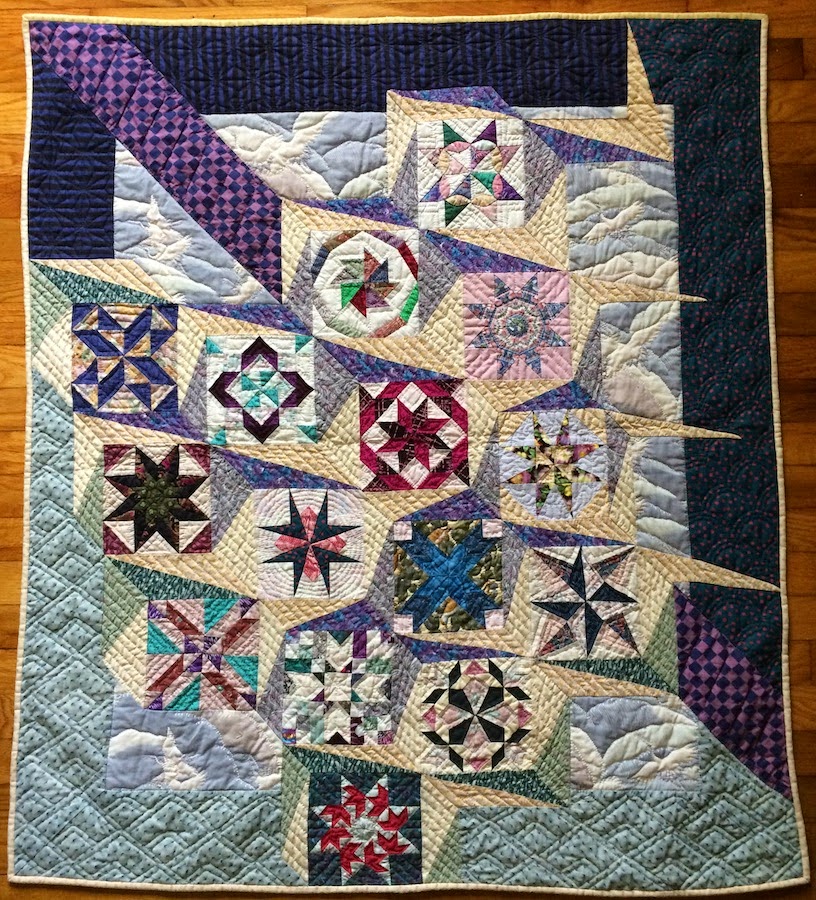
Number 2: This is the second instance of someone telling me that they had recently seen one of my quilts in a quilt related publication. The other instance involved a quilt of mine that was published in a book by Marie Salazar, 1997 called A Gallery of Quilts.  The quilt was one of my first attempts at asymmetrical design.  It is all hand pieced and quilted. The star blocks are 6" squares.

It's called "BIRDS of a FEATHER FLOCK TOGETHER" 1992.


 I did look the book up the other day and found a used copy at Amazon.  I don't know why I never received a copy of the book but I'll have one now.

Number 3: All of this reminded me that I had done some pretty creative work over the years I've spent as a quilt artist.

JOURNAL OUR WORK

Number 4: It's very important to journal our work. I was able to look up both of these quilts and get a full remembrance of the shows and publications that they have been in because I had put that information into a journal.   

Here is my journal entry for the "Kentucky Blue Skies" quilt:


 Several years ago, after I got a computer and digital camera, I started writing a formal journal of my work, on my computer and printing it out to go into a large binder.  I used hand written notes and show notices to get information about my earlier quilts. 

I now keep a catalog of photos on my computer for entering into my journal whenever I finish a new piece, at least, that's the plan.  I try to do a journal entry for each quilt as I finish it but I don't always keep up.  It is a lot easier to do the entry while one still remembers the fiber content of each material used, the name of the batting, the threads that were used, patterns, inspiration for the design, embellishments, the size of the quilt, etc.   

A journal like this could also be very helpful to anyone who might seeking an appraisal on the quilts that are in it. Only the artist really knows what they have intended artistically and the techniques that they have used and why.   When asked for an appraisal of my quilts, I have submitted very detailed journal pages with a full provenance with my quilt. Since I am the only appraiser around here, and I know better than anyone what has gone into the creation of my quilt,   the pages were accepted  by the show, even though technically,  I cannot appraise my own work.

 I also keep all show entries and other publicity about my quilts, including thank-you notes for loaning them out for exhibit.  One thing that I have not thought to do is to include an up to date photo of myself with my recent work.  Historically, this is an important validation of the claim that a certain person made the quilt. It's also good to keep an update biography on hand with the journal pages. It does not have to be very long.

This journal has been very important in reminding me of just what I have accomplished with this art of quilting and teaching in the last 37 years.   It's a great history of my growth as an artist in this wonderful world of quiltmaking and I"m loving it. It's also a great reminder of all the wonderful , beautiful and creative quilters that I've know and do know and call friends.

I encourage each of you to start keeping a journal of your quilted art work and to print it out. 

Creating Always,

Karen